
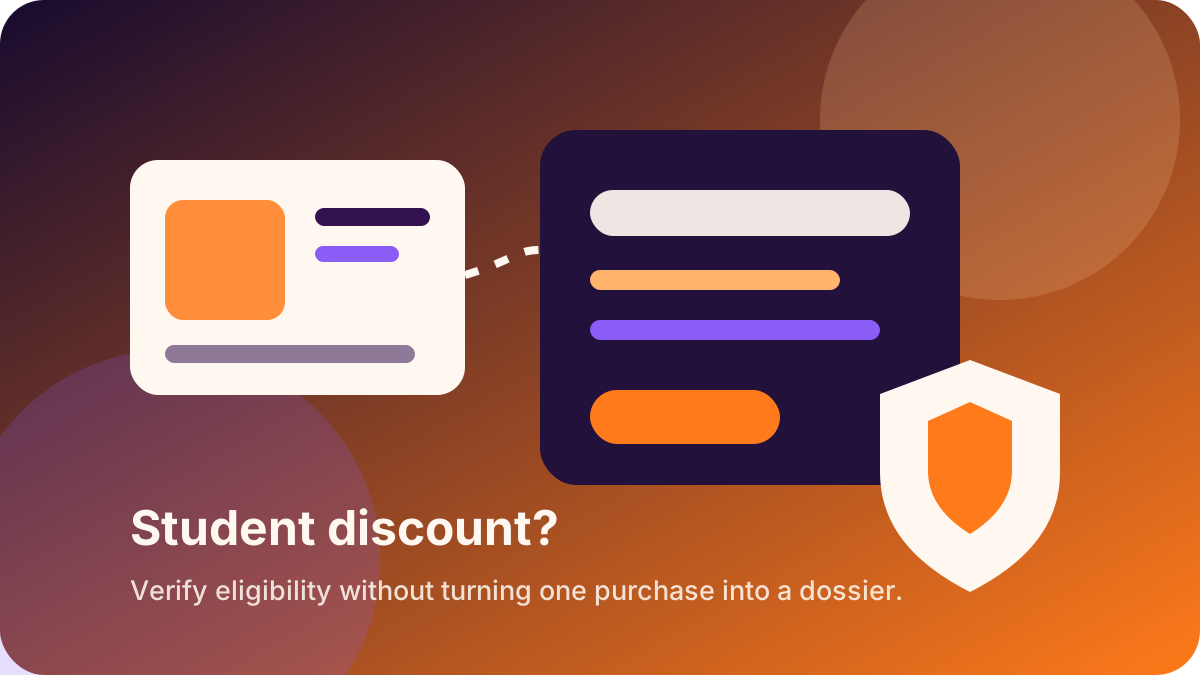
Are student discounts safe for privacy? They can be, but the privacy risk is not only the discount code. The risk is the verification flow around it: proving school affiliation, linking an email or account, adding a third-party verification service, and tying a shopper's status to a merchant profile at exactly the moment the shopper is trying to buy. For a student on a budget, a 10% or 20% discount can be worth the friction. The point is to understand what gets exchanged besides money.
The first privacy question is data minimization. A store may only need to know that a shopper is eligible for a discount, not the shopper's full school identity, graduation timeline, birthday, document image, or persistent account relationship. NIST's digital identity guidance is useful here because it treats identity proofing and authentication as risk decisions, not as a blank check to collect every possible attribute. A low-risk student-discount flow should prove eligibility without turning one purchase into an unnecessary identity dossier.
The second question is who else is added to the checkout. Some student discounts rely on outside verification vendors. That can be better than uploading documents directly to every merchant, but it still means another company may sit between the student and the purchase. The shopper should know whether the vendor is verifying a yes/no eligibility claim, storing documents, sharing attributes back to the merchant, or creating an account that can be reused across merchants. The visible benefit is a lower price. The invisible architecture is a new data relationship.
The FTC's dark-patterns work matters because these flows often appear in high-pressure shopping moments. A student may be comparing prices, racing a deadline, or responding to a limited-time offer. If the page buries privacy terms, nudges account creation, preselects marketing permissions, or makes the discount feel impossible without excessive disclosure, the interface is not just offering a perk. It is using a vulnerable decision moment to capture more durable identity data than the transaction may require.
Pew's privacy research explains why that trade feels bad even when nothing obviously breaks. Most Americans say the risks of company data collection outweigh the benefits, and many feel they have little control over what companies collect. Students face that problem with less margin for error: a school email, campus location, financial constraint, and buying history can combine into a profile that says more than 'eligible for discount.' It can imply age range, education status, budget pressure, geography, and life stage.
The surveillance-pricing concern is not that every student discount is secretly price discrimination. The careful concern is that eligibility, urgency, device, account, and purchase signals can be fed into systems that decide which offers to show, how hard to push, and what a shopper may tolerate. The FTC has already asked companies about products that use personal data and automated systems to influence prices or offers. Student status should not become another quiet lever in that machinery.
A practical privacy checklist is simple: prefer verification flows that return only eligibility, avoid uploading documents unless the benefit is worth it, use a school alias or limited email when appropriate, uncheck marketing boxes, review whether the verifier creates a reusable account, and do not let a small discount force a permanent merchant login. cloak's role is to make this trade legible. If a checkout adds identity proofing, third-party scripts, account linking, or pressure around a student perk, the shopper deserves to see that before the discount becomes the hook.