
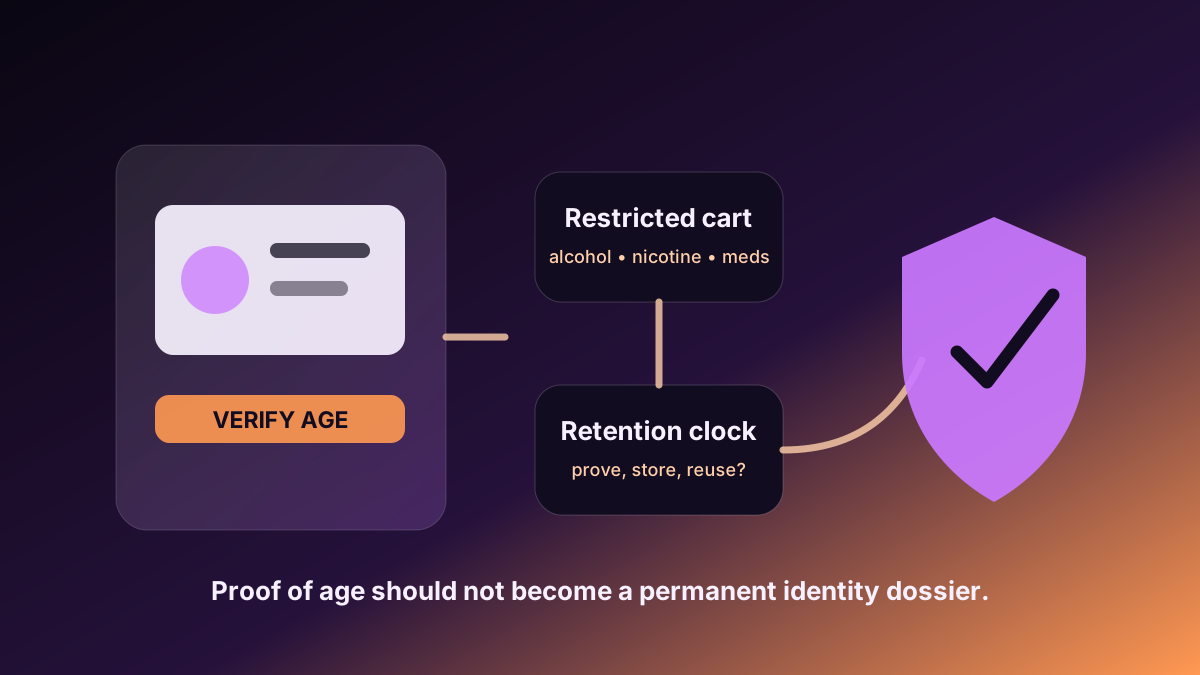
Age verification privacy risk appears whenever a checkout has to answer a narrow question—are you old enough?—with a much broader data flow. Alcohol, nicotine, cannabis where legal, certain medicines, gambling-adjacent products, adult products, knives, fireworks, and age-gated subscriptions can all trigger checks. Some verification is legally or operationally necessary. The privacy problem is when a simple age check turns into a copy of a driver's license, a face scan, address confirmation, device fingerprint, phone number, account login, and long retention period.
The FTC's 2026 COPPA policy statement shows why age verification is now a mainstream policy topic, not a niche checkout annoyance. The agency said it would not bring an enforcement action in certain COPPA contexts when personal information is collected, used, and disclosed solely to determine age under specified conditions. That word solely matters. The safest age check is purpose-limited: determine eligibility, minimize data, and avoid turning the process into marketing, profiling, or unrelated identity enrichment.
NIST's digital identity guidelines are useful because they separate identity proofing from ordinary account use. Stronger proofing can require stronger evidence, but that does not mean every merchant should collect the maximum possible evidence. Buying a restricted product is not the same as opening a bank account. If the merchant only needs to know that the customer is above a threshold, the privacy-preserving design goal should be to answer that threshold question without storing a full document image or reusable biometric template whenever possible.
Data minimization is the core rule of thumb. The CPPA's enforcement advisory frames collection, use, retention, and sharing as needing to be reasonably necessary and proportionate to the disclosed purpose. Applied to restricted-product checkout, that means the site should be clear about what it collects, whether a third-party verifier receives the data, whether the ID image is stored, how long audit logs persist, whether face or liveness checks are used, and whether the result can be reused without resubmitting sensitive documents.
The stakes are higher because restricted-product purchases can reveal sensitive household facts. A nicotine cessation product, fertility-related medicine, sexual-health item, adult product, addiction-recovery tool, or alcohol delivery order may be legal and ordinary, but it can still be private. If the age gate links that purchase to an ID scan, precise address, phone number, account, and device fingerprint, the user may create a more sensitive record than the product itself required.
EPIC and other privacy advocates have warned that age-verification systems can create broad collection pressure for all users, including adults. That warning applies to commerce too. A user may expect the store to check a birthdate at delivery, but encounter a third-party flow that asks for document upload, selfie match, SMS verification, or a persistent account. The friction can be framed as safety while the data becomes an identity asset.
A practical checklist is to prefer merchants that explain their age-check process before payment, use verification methods that reveal only the age result when available, avoid saving an ID scan to a general shopping account, read retention language, use delivery checks rather than pre-uploaded documents where lawful and practical, and pause if a restricted-product site asks for unrelated marketing consent, app permissions, or broad tracking. If the product is sensitive, consider whether a local purchase with in-person ID review creates a smaller digital trail than online checkout.
Parents and shared households need a separate warning. An age gate can attach an adult's identity to a purchase made for another person, or attach a young adult's ID to a family device that also carries school, health, and payment history. A narrow age result is easier to justify than a reusable identity trail that later follows the household into advertising, fraud scoring, or account recovery systems.
cloak's role is to warn when a compliance moment becomes exploitation. Age verification can be legitimate. But legitimacy does not excuse overcollection. Active privacy defense should distinguish a narrow proof-of-age check from a durable identity dossier, especially when the purchase category is sensitive and the user has little power to negotiate the data terms at checkout.